Sunday, February 22, 2026

Sweetgum - Liquidambar styraciflua

Hamamelidaceae - Witch-Hazel Family
"A Year With the Trees" - Tree Number 47
Sweetgum

Liquidambar styraciflua

Winter 2026 
February 16th

I visited with a big Sweetgum tree today.  This tree lives in front of my house.  It is around 75 feet tall.
There are no leaves or buds on this tree today.  There are a few remaining sweet gum spiky balls.  
I went out and hugged this tree and stood chest to bark and just breathed the tree in.  The day was warm and the sky was blue.  I felt quite peace filled after visiting with this sweetgum and grateful to be alive on this winters day.
I hope you may find a big sweetgum tree to hug on a beautiful winter day.


Spring
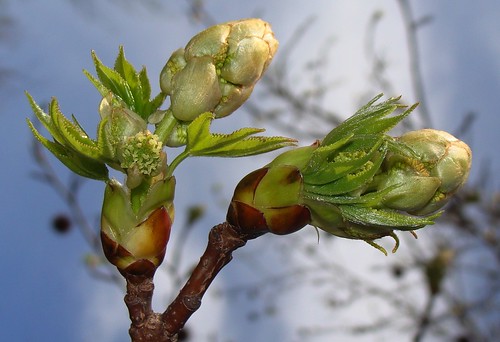
Leaves: The leaves are light green in the spring, alternate and simple. They have a distinct star shape with five points and deep V-shaped sinuses. The edges are finely toothed.
Twigs and Buds: The twigs and buds have a distinct pleasant odor when scraped with your fingernail or broken.


Summer

The name, Liquidambar, says it all. The resin of the Sweetgum tree is indeed a "liquid ambar".
The aromatic resin can be harvested from the tree trunk and used as incense, perfume, jewelry, soap, medicine, and adhesive.


The Sweetgum Tree in July.  Photo by Robert Priddy

The leaves have become a darker green since the spring. Some of the leaves have little tears and holes since they have been on the tree since spring. There is an incredible difference on the summer tree - the little green balls with the spikes. So beautiful!

The Sweetgum balls hold seeds, and the balls protect the seeds by the prickly spikes. These seeds hold the life of a new tree and they are also nourishment for birds and small mammals such as chipmunks and squirrels. There can be up to 50 seeds per ball. My daughter called it, "A holder of seeds" in a beautiful art piece she gave to a few years ago.

Sweetgum trees are the home for the caterpillar of the beautiful and romantic Luna Moth. The luna moth will live only a brief moment in time, coming out of it's cocoon by the light of the summer moon, finding its mate and flying together for a night and day before laying its eggs to begin life anew the following year....now, that is truly the essence of living in the moment.

I will be looking for the Luna moth this summer emerging from the Sweetgum Tree that lives by my house.

A Sweetgum leaf  in July

Fall


The Sweetgum Tree in October


The Sweetgum Tree in October light.
The Sweetgum tree is beginning to change color.

Winter


Height of a fully grown tree: Usually 80-100 feet in height and 2-4 feet in diameter.
Bark: Gray, furrowed with ridges.
Twigs: Frequently have corky ridges.
Fruit: Spiky balls will be hanging from the tree into the winter months. The trees are usually at least 30 years old before forming the spiky balls. The fruits are spherical up to 1.5 inches and have sharp points.
Buds: Large terminal buds are present.

Many wildlife eat the Sweetgum balls for nourishment in the winter. Birds and squirrels and chipmunks live around Sweetgum trees to reap the benefits of the nourishing value of the Sweetgum balls.

The gum produced in the bark has been used as chewing gum and also medicinally for sore throats, coughs, and colds. The essential oil of the leaf contains similar properties to Australian Tee Tree oil.


This Sweetgum ball has landed on a burning bush where it is resting on this cold January day. 

Champion Sweetgum Tree

The Champion Sweetgum tree lives in Burlington, New Jersey. It is
115 feet tall and has a circumference of 230 inches. See www.americanforests.org for more information on this national champion Sweetgum tree.
www.americanforests.org


For the love of the trees,
Becky


Liquidambar styraciflua


"The secret of health for both mind and body is not to mourn for the past, worry about the future, or anticipate troubles, but to live in the present moment, wisely and earnestly."
Budda

Friday, January 30, 2026

Yellowwood - Cladrastis kentuckea

Fabaceae - Bean Family
"A Year With the Trees" - Tree Number 30
Yellowwood

Cladrastis kentuckea

January 30, 2026
Check out this post to see pictures of this tree in all four seasons.

Spring


This tree is identified by its alternately compounded, 8-12 inch leaves. There may be 7-11 leaflets per leaf that are elliptical to ovate and 3-4 inches long each. The flowers are out in May. These flowers have been called the most beautiful tree flowers in the American Forests.  The flowers do not appear every year; just every 2-5 years.


The Yellowwood Tree in May at the North Carolina Arboretum
The Yellowwood Sign by the Yellowwood Tree at the North Carolina Arboretum

Summer


Yellowwood Tree at the Botanical Gardens of Asheville in June

My daughter and I  measured the Botanical Gardens tree for the Asheville Tree map a few years ago. We found our tape measure showed that three trunks all emerged from the base.  At 4 1/2 feet from the earth, we had three trunk measurements of 55 inches, 44 inches, and 37 inches.  I had planned to post this info on the website for the Asheville Tree Map.
The Asheville Tree Map is not active anymore.  We now have in the City of Asheville a Urban Forester. I will be reaching out to him to see if there in a new Asheville Tree Map that we are able to enter data about trees.

Fall 
The Yellowwood Tree

The Yellowwood Tree

This tree lives at the Asheville Botanical Gardens in the meadow over the green bridge near the Gazebo. It is so beautiful in the fall light. I could hear the seed pods today blowing in the cool breeze, it was the sound of fall's music.  www.ashevillebotanicalgardens.org

Winter


Yellowwood tree 

You can always identify this tree in the winter by seeing the dried pods hanging from the limbs and the smooth light-colored bark.

Yellowwood tree and the yellow-bellied sapsucker
photo by http://www.robertpriddyphoto.com/

This Yellowwood tree and yellow-bellied sapsucker both live at the Asheville Botanical Gardens.  www.ashevillebotanicalgardens.org


For the love of the trees,
Becky


Monday, January 26, 2026

January 2026

A Year With the Trees - 2026

Box Elder drawing by  Brooke Priddy Conrad

"And now let us welcome the new year; full of things that have never been."  Rainer Maria Rilke


The 93 trees of "A Year With the Trees" have been a big part of this journey since 2010. Each tree was sought out and found, offering a chance to sit quietly in its presence. From the network of veins in a leaf to the patterns of the bark and the land where each tree lives, every detail has a story to tell.

Up in the branches, birds and wildlife find a place to live and move. These trees change with the seasons: the bare branches of winter eventually give way to the new green growth of spring. Summer brings a fullness of life that slowly turns into the changing colors of fall. In the sunlight, the leaves turn to shades of gold, brown, red, and yellow. Even when the leaves fall to the ground and the branches are bare again, there is a quiet waiting for the new growth to return in the spring.

Visiting and journaling these 93 trees through every season reveals that there is always more to learn about them. It is a rewarding experience to walk through the woods, down a street, or in a park and recognize the trees as familiar friends. Developing this connection provides a sense of peace.

Beyond their beauty, trees are essential for life. We can breathe clean air and drink clean water because we live on the same planet with them. Their roots hold the soil in place, and their branches provide homes for birds, small mammals, moths, and butterflies. We share an interconnected world, and trees are its quiet protectors. 

"A Year With the Trees" was started as a way to share how to get to know the trees. Whether you are following along with all 93 or just getting to know a single tree in your neighborhood, these amazing Southern Appalachian trees have much to share with anyone who takes the time to look.

When one has an appreciation and gratitude for trees, one will naturally be led to protect and care for them.


Drawing by Rebecca Priddy


There is a journal booklet I created with the help of my husband, Robert and my daughter, Brooke Conrad.  I wanted to make this journal to help others get to know these trees.  I am editing it now to be able to hopefully put it online and/or  in printed form.  I will update this post when I get these journal booklets ready.  In the meantime, have fun out there in nature.  

For the love of the trees,

Rebecca


How Do Trees Inspire Me?


How do trees inspire me?

The PawPaw flower

Trees inspire me to be grateful for this moment,
to pause and see the beauty as a bud turns into flower.


Carolina Silverbell

Trees inspire me to learn their names.
To explore all the different colors , flowers and fruits they wear each season.

Black Locust Flowers
Trees inspire me to do share with others that we are all one sharing one planet.


Peace,


Rebecca

Saturday, January 24, 2026

Persimmon - Diospyros virginiana

Ebenaceae - Ebony Family
"A Year With the Trees" - Tree Number 24
Persimmon
Diospyros virginiana


The word Diospyros means "the fruit of the gods" in ancient Greek.

Spring


Persimmon Tree in the Spring
The green is very vibrant in the early morning spring light.
This tree lives at the Asheville Botanical Gardens.
http://www.ashevillebotanicalgardens.org/.

Persimmon Flower.  Thank you to Wikimedia commons for the use of this beautiful persimmon flower .   http://en.wikipedia.org/wiki/File:Persimmon_0375.jpg
This is a female Persimmon flower.  Both female and male flowers grow on the Persimmon tree.

Summer


Persimmon leaf teas have been used for many years in China, Japan, and in Korea.  These teas have been said to have numerous health benefits.  Benefits to health include improving blood lipid values, skin health, colon health, and many other health benefits have been reported as far back at 1000 years.
Persimmon fruit growing in the summertime
Fall

Persimmon fruit growing in West Virginia in the fall.  Photo by Robert Priddy

Persimmon in the fall.
The fruit before it ripens is very astringent.  I wanted to know what that meant, astringent.  So, I tasted a a persimmon back in June when the fruit was green.  I discovered what astringent means.  It means every single drop of moisture in your mouth is sucked out.  I had the driest mouth I ever had in my whole life.  So, today, needless to say, I was a bit skeptical to try and taste this now ripe fruit.  I have heard it said, not to eat the persimmon until they start to fall from the tree.  For, then and only then, are they ripe.  Well, today, on my walk about, there were persimmons on the ground.

So, I picked one up off the ground and I felt the persimmon.  It was quite soft.  I smelled the persimmon, I did notice a sweet-like scent, that was new to me.  After touching and smelling, I decided to taste.  I bit into the soft flesh of the persimmon fruit.  I was so amazed at what I tasted.  The fruit was so sweet, like a heavenly date-like nectar.  I had to taste more.  They were all a gift from the tree.  I thanked the tree and will be sure to go back tomorrow for another taste of heaven.
May you all find a persimmon tree on just the right fall day
Winter


Persimmon Tree that lives at the Asheville Botanical Gardens
The bark of the Persimmon tree is distinctive with a dark deeply-fissured, rectangular blocks.  The Persimmon tree is native to the eastern US.

From Wikipedia:  "In philosophy, the painting of persimmons by Mu Qi (13th Century) exemplifies the progression from youth to age as a symbol of the progression from bitterness to sweetness. The persimmon when young is bitter and inedible, but as it ages it becomes sweet and beneficial to humankind. Thus, as we age, we overcome rigidity and prejudice and attain compassion and sweetness. Mu Qi's painting of six persimmons (http://en.wikipedia.org/wiki/Six_Persimmons) is considered a masterpiece."


For the love of the trees,

Rebecca


Friday, January 23, 2026

The Apple tree and a poem


Apple Tree

“There is a pleasure in
the pathless woods,
There is a rapture on the
lonely shore,
There is society, where
none intrudes,
By the deep sea, and
music in its roar:
I love not man the less,
but Nature more.”
-Lord Byron


For the love of the trees,
Rebecca


Eastern Red Cedar - Juniperus virginiana - A Year With the Trees, tree number 23

Cupressaceae - Cypress Family
"A Year With the Trees" - Tree Number 23
Eastern Red Cedar
Juniperus virginiana

Eastern red cedar is actually not a cedar. It is a juniper. The red cedar is the most common native conifer in the Eastern United States. Its seeds are spread by cedar waxwings and other birds that eat the blue seed cones. The berries are so blue!

Spring

Juniperus virginiana
The small pink flowers on the Red Cedar will turn into a blue berry-like cone.

This next image is a Red Cedar tree with a Rust Gall.  These are quite interesting.  These do not harm the Cedar tree; yet they are cause much havoc to apple and crab apple trees.

Cedar Apple Rust
These trees are so important to the birds in the winter. The berry-like cones provide food during the winter months. Cedar waxwings, American Robin, Northern Bobwhite, Turkey, Starling, Mourning Dove, Northern Mockingbird, Purple Finch, American Crow, Northern Flicker, Downy Woodpecker, and the Eastern Bluebird all eat the berry-like cones of this tree. If you want birds to come visit where you live, plant these trees and enjoy.

Summer

Eastern Red Cedar - Juniperus virginiana
The Red Cedar is important to wildlife, it is beautiful, and it lives a very long time (400 plus years). The berries (cones) on this tree are colorful and used in herbal medicine as well as providing food for birds. The bark is colorful, interesting, and smells wonderful.

This Juniperus virginiana tree is filled with blue berry-like female cones.
Fall

Juniperus virginiana in September in Arkansas

Winter

I took these winter images today,  the evergreen foliage stays on the cedar tree all winter long.  This Eastern Red Cedar lives at Priddy Woods, and is my favorite Cedar tree.  It faces the sunset and just shines with light through its boughs every evening.  I am grateful for the peace I always feel when I watch the sunset through the branches where he light is caught in each little green whorled stem.   


For the love of the trees,
Becky


Thursday, November 20, 2025

Scarlet Oak

Fagaceae  Family - Scarlet Oak
"A Year With the Trees" - Tree Number 38
Quercus coccinea


The scarlet oak that dropped these leaves about a week ago, shares the same land I live on.  I watch and visit with this magnificent tree all year round.  The day these leaves fell, it was cold and windy.  I picked up these beautiful scarlet colored leaves and took this photo on white paper to be able to really see the scarlet color,  

I am so grateful for the trees I live beside.  To see the birds that visit the tree, to hear the wind in tree branches, to breath in the fresh air, to feel the leaves falling around me, and to touch the strong bark with my hands, these moments always bring me to the present moment.  Being present is what helps to keep me calm in what often seems a chaotic world filled with too much to do.  

Enjoy finding your own moments by a tree and embracing the time with all your senses.

My practice for the past 15 years has been to visit each of the 93 trees on this blog once per season. When I am with the tree, I am quiet and use all my senses.  Sight, hearing, smell, touch, and even tasting when possible..  These trees have become part of me; I have a love for trees that makes me who I am.  

My favorite visits with the trees include carrying my journal and writing about my time with the tree. Writing about the birds that were there with me and the tree, the weather, the leaves, the limbs, the fruits and anything I feel about the tree and anything I feel the tree communicating with me.  I might add a drawing of a leaf or the trunk or the fruit.  Anything goes. 

For the love of the trees,
Becky


Saturday, February 22, 2025

Winter at the Botanical Gardens in Asheville, North Carolina 2025

I went to the Botanical Gardens yesterday with Brooke, my daughter, we had not been there since Hurricane Helene came through Asheville.  The Gardens were closed to visitors for months and this is the first time we observed the changes that happened when the storm came through.

We walked  to sycamore meadow and saw the magestic sycamore was down on the ground.  I felt shock and awe and sadness and hope all at once.  


I also felt grateful that the Botanical Gardens will leave the Sycamore tree where it lays.  This meadow was named for the cluster of sycamore trees in this area of the gardens.  This meadow is also the home of another special sycamore, the Moon tree, whose seeds flew to the moon and back aboard the Apollo spaceship.

The botanical gardens at asheville are currently working on preparing the fallen Sycamore tree so the visitors that come to the garden will be free to interact with the tree by touching and sitting on the fallen Sycamore tree. 

This is my page from my “A Year With the Trees” journal.  You can see where Brooke drew the outline of the trunk as it lays on the ground. 

If you get a chance go visit the beautiful Sycamore meadow at the botanical gardens of Asheviile.  

Peace,

Becky Priddy


Rosebay Rhododendron

October 28, 2026 Today’s tree is the Rosebay Rhododendron.  The leaves today are spectacular in western North Carolina. Rosebay is calling m...