Saturday, February 17, 2018

Chestnut Oak - Quercus montana

Fagaceae - Beech Family
"A Year With the Trees" - Tree Number 41
Chestnut Oak
Quercus montana


Spring


Quercus montana- Chestnut Oak 
Brightly colored young Chestnut Oak leaves are coming out of their buds in the spring.


The leaves of the chestnut oak are wavy edged. The Oak is late putting out it's spring leaves. The April leaves are still quite small.

Summer


The Chestnut Oak in July; the acorns are growing.

Young developing Chestnut oak acorns and late summer leaves

The Chestnut Oak Tree in July
The leaves of the Chestnut tree are simple, alternate, and wavy (almost toothed) edged. These leaves can be up to 10 inches long and 3 inches wide. The acorns are coming out now and are still green. This tree usually grows up to 80 feet in height.

Fall


The Chestnut Oak and the Wheel Bugs in September
This amazing tree complete with the wheel bugs lives right outside my window. I follow the changes of the seasons with this beautiful tree. Now that it is September, its leaves are changing. The leaves have little holes in them; and the green is darker, not the same green it was when the leaves first appeared. Acorns and insects are all over the Chestnut Oak outside my window on this bright September day.

The wheel bugs are a type of assassin beetle. The wheel bug is considered a beneficial insect because it eats harmful insects, such as sawflys, aphids and Japanese beetles. It is not a good idea to handle these bugs for they bite and the bite is said to be painful. The good news is that these bugs do not come after you. They are very slow (said to be one of slowest bugs ever) and will not bother you unless you bother them.

During late summer the Wheel bugs mate and the female will lay her eggs in the twigs of the tree. The female will lay 40-200 eggs only once. She will die soon after laying her eggs and possibly eating her mate as well. Yikes! They are known to be efficient assassins; they come complete with armor, weapon, and poison for killing their prey. Thus, the name, assassin.


Winter


The Chestnut Oak in winter.
The leaves are still lingering on the Chestnut Oak Trees. The bark is dark gray to brown, and the twigs are reddish brown and smooth. The buds are acute and 1/2 inch long. The acorns are about 1-1.5 inches long, with a deep bowl shape enclosing half the nut.


For the love of the trees,

Becky


A page from my journal


Blackjack Oak - Quercus marilandica

Fagaceae - Beech Family
"A Year With the Trees" - Tree Number 40
Blackjack Oak
Quercus marilandica


Spring


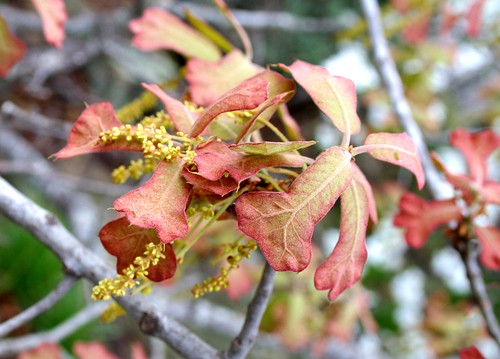
Quercus marilandica leaves and flowers

Quercus marilandica leaves and flowers

http://www.flickr.com/photos/akbuthod/2387596991/
amy_b  
This Oak may just be one of the most beautiful Oak trees in the world; just look at that new spring growth color!!!


Summer


Blackjack Oak in Cookeville, Tennessee
The Blackjack Oak Leaf
This tree grows to 40+ feet and lives a long life like most oaks.

Fall


This Blackjack Oak tree lives in Mountain Home, Arkansas


Winter


For the love of the trees,
Becky


The Black jack Oak
Quercus marilandica

Friday, February 16, 2018

Southern Red Oak - Quercus falcata

Fagaceae - Beech Family
"A Year With the Trees" - Tree Number 39
Southern Red Oak
Quercus falcata


Spring
Southern Red Oak, Quercus falcata


Summer

Southern Red Oak, Quercus falcata

Southern Red Oak, Quercus falcata

This southern oak lives in Cookeville, Tennessee, at my Sister's house. This beautiful oak tree is probably 80 feet tall. I love this tree. It reminds of strength; probably because this tree stands so tall and strong each day through the seasons, year after year. It is beautiful, providing food and shelter for countless birds and small mammals.

The leaves of this tree are variable. However, they most always have a long narrow lobe in the center of the leave that is sometimes called a finger. The upper sides of these leaves are shiny green and the undersides are dull with felt-like hairs. The Southern Red Oak has a characteristic bell-shaped leaf base.

I want to climb a big Southern Red Oak tree, and I may just get the opportunity. I found out that Panola Mountain State Park in Georgia has a Southern Red Oak Tree Climbing program. They call it a Nocturnal Tree Top Excursion. Here is a quote from what I read:

Nocturnal Tree Top Excursion

Experience climbing trees like you never have before with a rope and harness at night.
Participants will climb a 90-foot Southern Red Oak. This nocturnal climb will include
fluorescent lichen and other glowing critters of the night, stargazing and night climbing
activities. To register in advance or for more information call 770-389-7801. $20 plus $3
parking.
Panola Mountain State Park / 2600 Ga. Hwy 155 SW, Stockbridge, GA 30281
770-389-7801


The biggest Southern Red Oak in the National Register of Big Trees is in Upson, Georgia. It has a circumference of 341 inches. It has a height of 137 feet. It has been the champion since 1996.
http://www.americanforests.org/big-trees/southern-red-oak-quercus-falcata-2/

A Southern Red Oak leaf that grows on the tree in my Mom and Sister's yard in Tennessee.  

Fall

The Southern Red Oak leaves in September.  This leaf is distinctive with the rounded base.  


Quercus falcata, Southern Red Oak in November

I sat under a 60 foot tall Southern Red Oak one morning in November.  The wind was blowing, bringing the yellow and brown oak leaves all around me.  I lifted up my arms to catch the falling leaves as the wind blew my hair all around my face.  As I looked around I noticed that all the other trees around me were bare except for the oaks.  The oaks were all contributing their leaves to the wind.  To stand under tall oak trees on a windy fall day in November is one of my lifes favorite kind of days.

Winter


Southern Red Oak


Southern Red Oak


For the love of the trees,
Becky
A Page from my journal, The Southern Red Oak

"Trees are sanctuaries. Whoever knows how to listen to them, can learn the truth."
Hermann Hesse

Another journal drawing

Scarlet Oak - Quercus coccinea

Fagaceae - Beech Family
"A Year With the Trees" - Tree Number 38
Scarlet Oak
Quercus coccinea


Summer

The Scarlet Oak Tree.  This Scarlet Oak lives at the Asheville Botanical Gardens.

Scarlet Oak that lives at the Asheville Botanical Gardens 


The Leaves: Alternate, simple, 4 to 7 inches long, very deep, bristle-tipped lobes, glossy green above, paler and glossy on the underside of the leaf. The tree usually grows up to 80 feet tall.


Fall
The Scarlet Oak Tree


The Scarlet Oak Tree

Today, I got out my macro lens to photograph the Scarlet Oak; now I know why the Scarlet Oak is called scarlet.


Winter

Scarlet Oak photo coming soon!


Spring


This Scarlet Oak lives at the Asheville Botanical Gardens.  www.ashevillebotanicalgardens.org.

Early Spring Bud of the Scarlet Oak

For the love of the trees,
Becky

Thursday, February 15, 2018

White Oak - Quercus alba

Fagaceae - Beech Family
"A Year With the Trees" - Tree Number 37
White Oak
Quercus alba


Summer


White Oak, Quercus alba
photo by Robert Priddy
http://www.robertpriddyphoto.com/
Fall


White Oak, Quercus alba
The sweet tasting acorns of the White Oak are the acorns of choice of many animals.

A sign of fall is when the Oak trees are filled with acorns. This incredible White Oak tree is brimming with acorns. It is said that 180 animals and birds eat Oak acorns.

The White Oak can grow up to 100 feet and live 300 years. It's leaf is easily identified by its curved lobes. The leaves will soon be changing to a purple red color. The National Champion White Oak lives in Brunswick, Virginia. It is 83 feet tall and has a circumference of 312 inches. You can read more at www.americanforests.org.

The White Oak tree in this image lives in Mountain Home, Arkansas.
  The acorns are growing still in September.
  I am glad to see so many acorns.  For I know that the wildlife will have food in the winter.


Winter


The White Oak Tree in winter still holding onto it's leaves.

The White Oak Tree in Winter.
The White Oak Tree in Winter - Quercus alba

Spring

to be included in the spring of 2020.....

For the love of the trees,

Becky


Sunday, February 11, 2018

American Beech - Fagus grandifolia

Fagaceae - Beech Family
"A Year With the Trees" - Tree Number 36
American Beech
Fagus grandifolia


Spring
Young leaves of the Fagus grandifolia tree
This tree lives on a mountainside near Asheville, North Carolina. Five things I learned about the American Beech are:
  • The leaf margins are called bluntly serrate; can you see how that description fits by looking at the leaf?
  • The leaf veins are all parallel to each other and very prominent.
  • Many people believe that oils in the beech trees protect the trees from lightening strikes. 
  • The American Beech tree is part of the Fagaceae Family, which is also the family of the American Chestnut.
  • This is a slow growing tree that can reach a height of 100 feet.
Fagus grandifolia male flowers
Did you know that there are insects and amphibians that live entirely on Beech trees? I hope if anyone out there has Beech trees that they will protect them and keep them safe. These slow growing trees take many years to produce their beechnuts. They are extremely slow growing; yet, they are valuable to the life of many lives.

Find a beech forest and watch....you will be amazed. May we all find a beech tree forest in our lifetimes...complete with the red backed salamander....

Summer


Fagus grandifolia, American Beech

Fall
A Smokey Mountain Beech Gap

A Smokey Mountain Beech Gap
The Beech Gap in the Smokies

Perhaps this is the most breathtaking place I have ever been.  
Is it the color of the Beech leaves against Fall's blue southern sky?  
Is it the way we are all silent and just standing in the presence of something far greater than ourselves?
I can not comprehend all that I feel as I stand in this place. 

Beech Gaps are here with us on this planet in ever shrinking numbers.  These habitats are home to species that only live in and around these trees.  May we all do our part to learn all we can as to how we can protect and preserve the biodiversity of the Beech Gaps on the earth.  You can visit this Beech Gap and experience the awe yourself.  It is near Indian Gap in the Great Smokey Mtn. National Park in Tennessee.

Thank you, Jeremy Lloyd, who teaches at Tremont Institute, for teaching our Class on Southern Appalachian Ecology and taking us to the Beech Gap. www.gsmit.org


Winter


Fagus grandifolia's pointed bud


The Beech Tree


The Beech Tree
This tree is easy to identify in the winter months for it holds on to it's light colored leaves when most trees have already shed their leaves. The bark is smooth which is another clue. The oaks that still hold onto their leaves look very different; for their leaves are darker and the bark is not smooth like the American Beech.

These tree's leaves seemed to be glowing in the dark overcast day. Glowing, like lanterns. http://www.ashevillebotanicalgardens.org/


This  tree is what is called a marcescent.  Marcescent trees keep their leaves on throughout most of winter. Go outside and when you see trees with their leaves still hanging on it is a marcescent. The Beech Trees and Oak Trees are marcescents.


For the love of the trees,
Becky
Fagus grandifolia from my journals


Allegheny Chinquapin - Castanea pumila

Fagaceae - Beech Family
"A Year With the Trees" - Tree Number 35
Allegheny Chinquapin

Castanea pumila


Spring


Young leaves of the Allegheny chinquapin 
This Allegheny chinquapin lives on a mountain side near Asheville.  This is a close relative to the American chestnut.  The Allegheny chinquapin is much smaller than the American chestnut.

Summer


Allegheny chinquapin

This photo is of a Allegheny chinquapin that grows in my yard. It is a beautiful tree like the American chestnut, and I am glad to have it live in my yard. I do want to see a tall and mighty American chestnut and plan to take a trip to see some of the survivors.


Fall 
Photos and images to be added as I create them.  So, hopefully, coming in the Fall of 2018.  Anyone want to donate an image to the blog?  Just let me know.


Winter


Photos and images to be added as I create them.  So, hopefully, coming in the Winter of 2018.  Anyone want to donate an image to the blog?  Just let me know.


For the love of the Trees,
Becky
Allegheny Chinquapin leaf from my journal.

Rosebay Rhododendron - Rhododendron maximum

Ericaceae - Heath Family "A Year With the Trees" - Tree Number 28 Rosebay Rhododendron Rhododendron maximum Spring The Roseb...